Quick answer: There isn’t one liability limit that’s right for every Florida driver. While many drivers carry only the minimum required coverage, higher liability limits can better protect your income, savings, and future—and they often cost less than people expect. The right choice depends on your budget, assets, and comfort with risk.
Florida’s minimum auto insurance requirements don’t always provide as much protection as drivers think. This article explains bodily injury liability, uninsured motorist coverage, FR-44 limits, and how to balance stronger protection with real-world budget considerations.
One of the biggest misconceptions about Florida auto insurance is that the “minimum coverage” actually protects you well in a serious accident.
It often doesn’t.
Florida’s minimum required coverage is:
$10,000 Personal Injury Protection (PIP)
$10,000 Property Damage Liability (PD)
Notice what’s missing:
Bodily Injury Liability coverage is not required for most Florida drivers.
That surprises a lot of people.
Why Florida Doesn’t Require Bodily Injury Liability
Florida is a “no-fault” state.
That means your own insurance company pays the first portion of your medical bills through PIP coverage, regardless of who caused the accident.
PIP generally helps cover:
Medical expenses
A portion of lost wages
Certain related expenses
But PIP is limited.
And in today’s world, $10,000 in medical costs can disappear very quickly after even a moderate accident.
That’s why bodily injury liability coverage matters so much.
Liability is only one part of the policy. For the complete picture, see how Florida auto insurance coverage and claims work together before and after an accident.
What Bodily Injury Liability Actually Does
If you cause an accident and injure someone else, bodily injury liability coverage helps pay for:
Their medical bills
Lost wages
Pain and suffering claims
Legal defense costs
Potential settlements or judgments
Without it, you may be personally exposed.
And in Florida, injury claims and lawsuits after serious accidents are not uncommon.
The Financial Responsibility Problem
Here’s the part many drivers don’t understand:
Even though Florida may not initially require bodily injury liability, the Financial Responsibility Law can still affect you after an at-fault accident.
Florida’s basic financial responsibility thresholds are commonly referenced as:
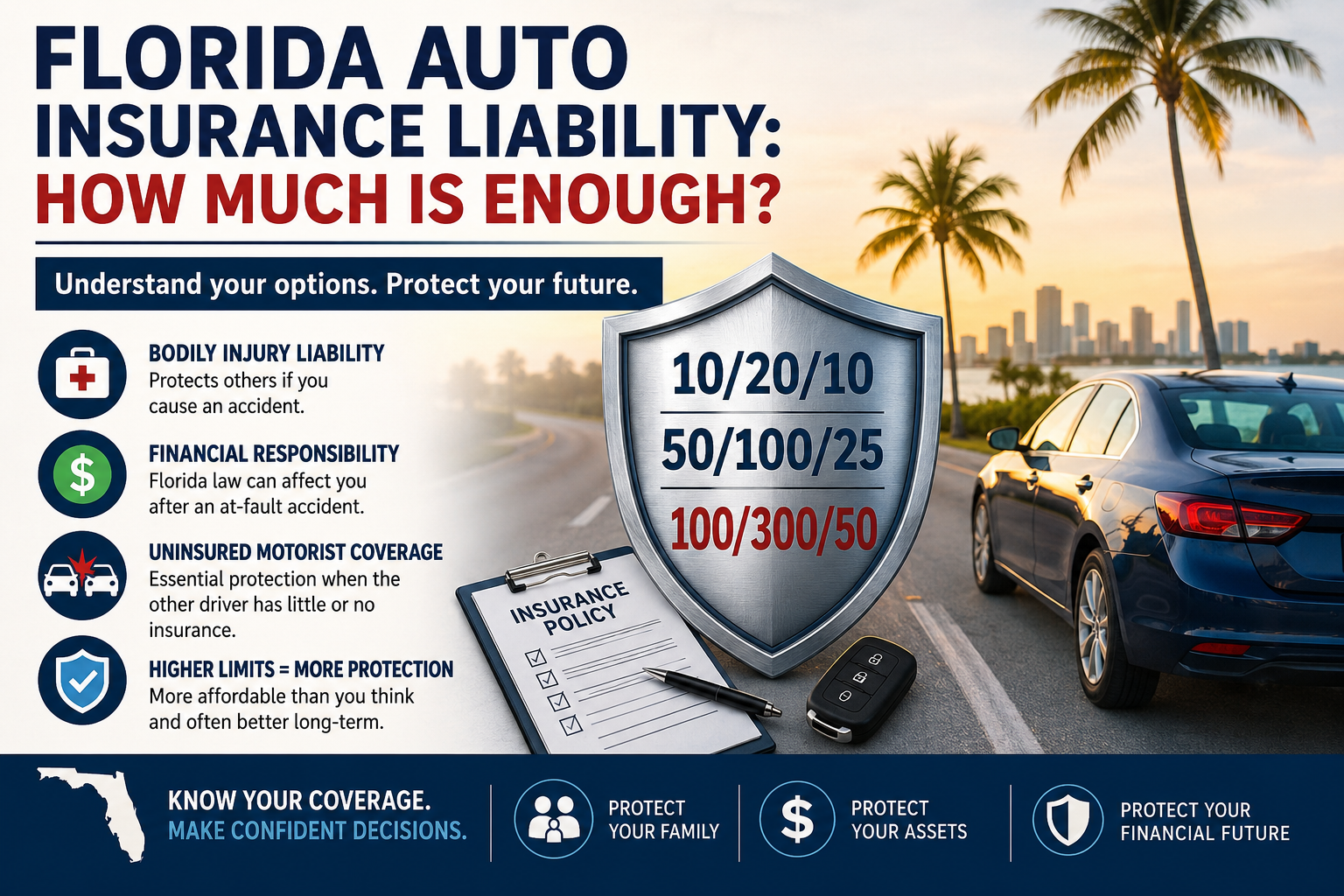
10/20/10
Meaning:
$10,000 bodily injury per person
$20,000 bodily injury per accident
$10,000 property damage
If you cause an accident with injuries and cannot satisfy those financial responsibility requirements, several things can happen:
Your license may be suspended
A judgment could be entered against you
You may later be required to carry an SR-22
Future insurance options can become more limited and expensive
That’s one reason many agents strongly recommend carrying at least some bodily injury liability coverage — even if Florida technically doesn’t require it upfront.
Many Florida drivers eventually discover that minimum coverage is not always the cheapest option long-term, especially after an at-fault accident or license suspension issue.
Is 10/20/10 Enough?
Honestly, serious injuries can exceed $10,000 extremely fast.
An ambulance ride, emergency room visit, imaging, physical therapy, or surgery can push medical costs far beyond minimum limits almost immediately.
That’s why many drivers choose higher limits such as:
100/300/50
Meaning:
$100,000 bodily injury per person
$300,000 bodily injury per accident
$50,000 property damage liability
Those limits are often viewed as a more comfortable middle ground for drivers concerned about protecting themselves financially.
Years ago, many leasing companies required these higher liability limits automatically as part of their lease agreements. Today, that’s less common, although some manufacturers and finance companies may still require it.
These same limits are also required for drivers carrying an FR-44 filing after a DUI in Florida. Drivers with an FR-44 generally must maintain those higher liability limits for three years following license reinstatement because the state considers those drivers higher risk.
A Real-Life FR-44 Example
One of my customers, Keenan H., is actually going through this exact situation right now.
I originally wrote his policy about three years ago when he needed an FR-44 filing after a DUI. Like every Florida FR-44 case, he was required to maintain:
100/300/50
for the entire FR-44 period.
He successfully maintained the policy continuously for all three years, and now his FR-44 requirement is ending.
That changes things significantly.
Without the FR-44 filing attached, his premium drops substantially. But now he faces the same decision many Florida drivers eventually face:
Should he keep the higher liability limits, or lower them to save money?
At the moment, he’s leaning toward basic liability because maintaining higher coverage can absolutely become expensive over time. But after finishing this article, I’m actually planning to send it to him because it’s an important discussion worth revisiting.
That’s the reality for a lot of drivers.
The right answer isn’t always obvious. It comes down to balancing:
Budget
Risk tolerance
Assets
Driving habits
Long-term financial exposure
And that’s especially true with Florida FR-44 insurance, where the filing itself is really an ongoing compliance process — not just an insurance policy.
This is also why asking whether a policy has “full coverage” does not answer whether its liability limits are sufficient.
Why Higher Liability Limits Often Aren’t as Expensive as People Think
A lot of people assume:
“Ten times the coverage must mean ten times the price.”
Usually, it doesn’t work that way.
The first layer of liability coverage is the portion most commonly accessed in claims.
Extremely large liability payouts are less frequent.
So as coverage increases, the additional cost per dollar of protection often becomes more efficient.
That’s why moving from:
10/20/10 to
50/100/50 or
100/300/50
is sometimes more affordable than people expect.
There’s another factor many people don’t realize:
Insurance companies often rate prior liability coverage levels very heavily.
Drivers who consistently carry 100/300/50 or similar higher limits are often viewed more favorably from an underwriting perspective than drivers who carry minimum limits or no bodily injury liability at all.
Because of that, carriers frequently offer stronger pricing and better underwriting treatment to drivers who maintain higher prior liability limits over time.
So while higher limits do cost more upfront, maintaining strong prior coverage history can sometimes help offset future pricing compared to someone who has always carried only minimum coverage.
That’s an important part of the conversation too.
And honestly, many of the invisible factors affecting Florida auto insurance pricing happen quietly in the background through underwriting models most drivers never even realize exist.
One Extremely Important Consideration: Uninsured Motorist Coverage
For many Florida families, the biggest concern isn’t just protecting other people.
It’s protecting themselves and their own passengers.
That’s where uninsured motorist coverage becomes incredibly important.
Uninsured motorist coverage can help protect you and your family if:
another driver causes an accident,
has little or no bodily injury liability coverage,
or doesn’t have insurance at all.
And in Florida, that situation happens far more often than many people realize.
One important rule many drivers don’t know:
You generally cannot purchase more uninsured motorist coverage than the bodily injury liability limits you carry on your own policy.
So if you carry:
10/20/10
for bodily injury liability, you’re generally limited to those same uninsured motorist limits.
But if you carry:
100/300/50
then you open the door to substantially stronger uninsured motorist protection for yourself and your family.
For many drivers, that alone becomes one of the strongest arguments for carrying higher bodily injury liability limits in Florida.
If you really want to understand how uninsured motorist coverage works — including stacked versus non-stacked coverage and why it matters so much in Florida — it’s worth taking a deeper look at how uninsured motorist coverage actually protects Florida drivers.
One Area Many Drivers Overlook: Property Damage Liability
A lot of attention gets placed on bodily injury liability, but property damage liability deserves serious consideration too.
In a 10/20/10 policy, that last number represents:
$10,000
for property damage liability coverage.
In today’s world, that’s not much.
Modern vehicles are packed with:
Sensors
Cameras
Radar systems
Advanced bumpers
Expensive headlights
Calibration technology
It’s now very easy for a relatively moderate accident to cause property damage well beyond $10,000.
Sometimes a single bumper assembly with sensors and calibration can approach or exceed that amount by itself.
In many cases, the difference in premium between $10,000 property damage liability and $25,000 property damage liability is fairly modest.
That’s one reason I frequently quote:
At least $25,000 Property Damage liability for drivers who are budget conscious but still want a more practical level of protection.
Property damage claims occur far more frequently than catastrophic bodily injury claims, so increasing that portion of the policy can often provide meaningful additional protection for a relatively small increase in premium.
The Bottom Line
Florida’s minimum coverage requirements were never designed to fully protect most drivers in a serious accident.
PIP helps cover the initial medical expenses regardless of fault, which is why Florida doesn’t mandate bodily injury liability for everyone from the start. But PIP alone is limited, and it does not replace the need for meaningful liability protection.
At the same time, after years of working with Florida drivers every single day, I also understand something else very clearly:
Most everyday people are working within real-world budget limitations.
Auto insurance is already expensive, especially in today’s environment where housing costs are up, groceries are up, vehicle prices are up, repair costs are up, and overall cost of living pressures continue rising.
For many policyholders, there’s simply a limit to what comfortably fits into the monthly budget.
And honestly, many people also make a very practical decision:
They choose not to spend significantly more money on protection they may realistically never use.
A lot of drivers go their entire lives without a serious accident, without a lawsuit, without a catastrophic injury claim, and without ever fully accessing those higher liability limits.
So from their perspective, paying substantially more year after year for coverage they may never use doesn’t always feel practical.
That’s a completely understandable viewpoint too.
Everybody’s situation is different.
Some people are extremely liability conscious and want as much protection as possible.
Others are more focused on affordability and simply want solid, responsible coverage that fits within their budget comfortably.
Neither approach is automatically “right” or “wrong.”
It really comes down to your budget, your assets, your family situation, your tolerance for risk, and your personal comfort level financially.
That’s why these conversations are so individualized.
And one important thing many people forget:
Your coverage choices are not permanently locked in forever.
Liability limits, uninsured motorist coverage, deductibles, and other policy options can usually be revisited and adjusted during the policy period through an endorsement if your circumstances, finances, or comfort level change later on.
Sometimes the smartest insurance decision isn’t choosing the absolute maximum coverage possible.
Sometimes it’s choosing a level of protection that keeps you properly insured, keeps you financially comfortable, and allows you to maintain your coverage consistently long term.
That balance is different for everyone.
Related Florida Auto Insurance Guides
Whether you’re buying a new policy, comparing quotes, understanding Florida insurance laws, or looking for ways to lower your premium, these in-depth guides will help you make more informed insurance decisions.
• Florida Auto Insurance – Start with our complete guide to buying, comparing, and understanding Florida auto insurance from the ground up.
• Florida Auto Insurance Coverage and Claims – Learn how liability, collision, comprehensive, uninsured motorist coverage, and the claims process work before you ever need them.
• Florida Auto Insurance Laws and Requirements – Understand Florida’s insurance laws, minimum coverage requirements, FR-44 and SR-22 filings, and the legal responsibilities every Florida driver should know.
• Safe Driving & Saving Money – Discover the many factors that influence your premium, practical ways to reduce your insurance costs, and how smart driving habits can help you save over time.
• Florida FR-44 Insurance – Everything Florida drivers need to know about FR-44 insurance after a DUI, including filing requirements, reinstatement, non-owner policies, and affordable coverage options.
Continue Reading About Florida Auto Insurance Coverage & Claims
If you found this guide helpful, these articles explore Florida auto insurance coverage, claims, and settlement issues in greater detail:
Florida Auto Insurance Coverage & Claims: What Your Policy Actually Does — And What Happens When You File a Claim (This article) – Start with our complete guide to understanding what your Florida auto insurance policy covers, how claims work, and how to make smarter coverage decisions.
How Much Liability Insurance Do I Really Need in Florida? (This article) – State minimum limits may satisfy Florida law, but they may not adequately protect your income, savings, or future. Learn how to choose liability limits that fit your personal financial situation.
What Is Full Coverage Car Insurance in Florida? – Many people ask for “full coverage,” but the term has no legal or insurance definition. Find out what it usually includes and how to decide whether it’s appropriate for your vehicle.
Uninsured Motorist Coverage in Florida – What happens if the driver who hits you has little or no insurance? Learn why uninsured motorist coverage is one of the most valuable protections many Florida drivers can buy.
Florida Minimum Car Insurance Isn’t Always the Bargain It Looks Like – Florida’s legal minimum looks cheap upfront, but can cost more later in pricing and real exposure.
Do You Really Have to Call Your Insurance Company After a Minor Accident? – Not every accident automatically requires an insurance claim. Learn when reporting an accident makes sense, what happens after you report it, and how your decision can affect future premiums.
That Total Loss Number Doesn’t Look Right – Receiving a total loss settlement can be frustrating if the value seems too low. Learn how insurance companies determine actual cash value and what you can do if you disagree with the offer.
C.L.U.E. Reports: The Hidden Claim Record – Most drivers never realize that claims can continue affecting their insurance long after an accident is over. Learn what a C.L.U.E. report is, what information it contains, and why reviewing it can help you avoid surprises.
About the Author
Written by Clifford Schimek — Florida Auto & FR-44 Insurance Expert
I help Florida drivers every day with auto insurance quotes, liability protection decisions, and FR-44 filings. My goal is to make everything simpler and less stressful while helping drivers understand what they’re actually buying — not just what’s cheapest on paper. Liability limits are really just one piece of a bigger picture, which is part of why I think about auto insurance as an ongoing process, not a one-time purchase.
Clifford Schimek — Florida Auto & FR-44 Insurance Expert
Call or text: 305-796-2968
Learn More About Cliff
Why Clifford Schimek? – The case for working with me
Florida Auto Plus Insurance – Agency website
Florida FR-44 Information and Guidance – For Florida drivers who need an FR-44 filing
View my Google Business Profile – Reviews and Business information