Quick answer: Despite the name, there is no such thing as a “full coverage” car insurance policy in Florida. The term is simply shorthand for a combination of coverages. What actually protects you are the specific coverages, limits, and deductibles listed on your policy.
“Full coverage” isn’t a real policy — it’s a nickname. And misunderstanding it is one of the most common reasons Florida drivers end up either overpaying… or dangerously underinsured.
Let me say this clearly:
There is no such thing as “full coverage” in car insurance.
Not in Florida, not with any company, and not on any declarations page you’ll ever receive.
Because “full coverage” is only shorthand, use this complete guide to Florida auto insurance coverage and claims to see how each separate coverage, limit, and deductible performs.
Yet almost every day, I hear:
- “I need full coverage.”
- “Do I have full coverage?”
- “I don’t need full coverage anymore.”
It’s one of the most commonly used — and most misunderstood — phrases in auto insurance.
So What Do People Actually Mean By “Full Coverage”?
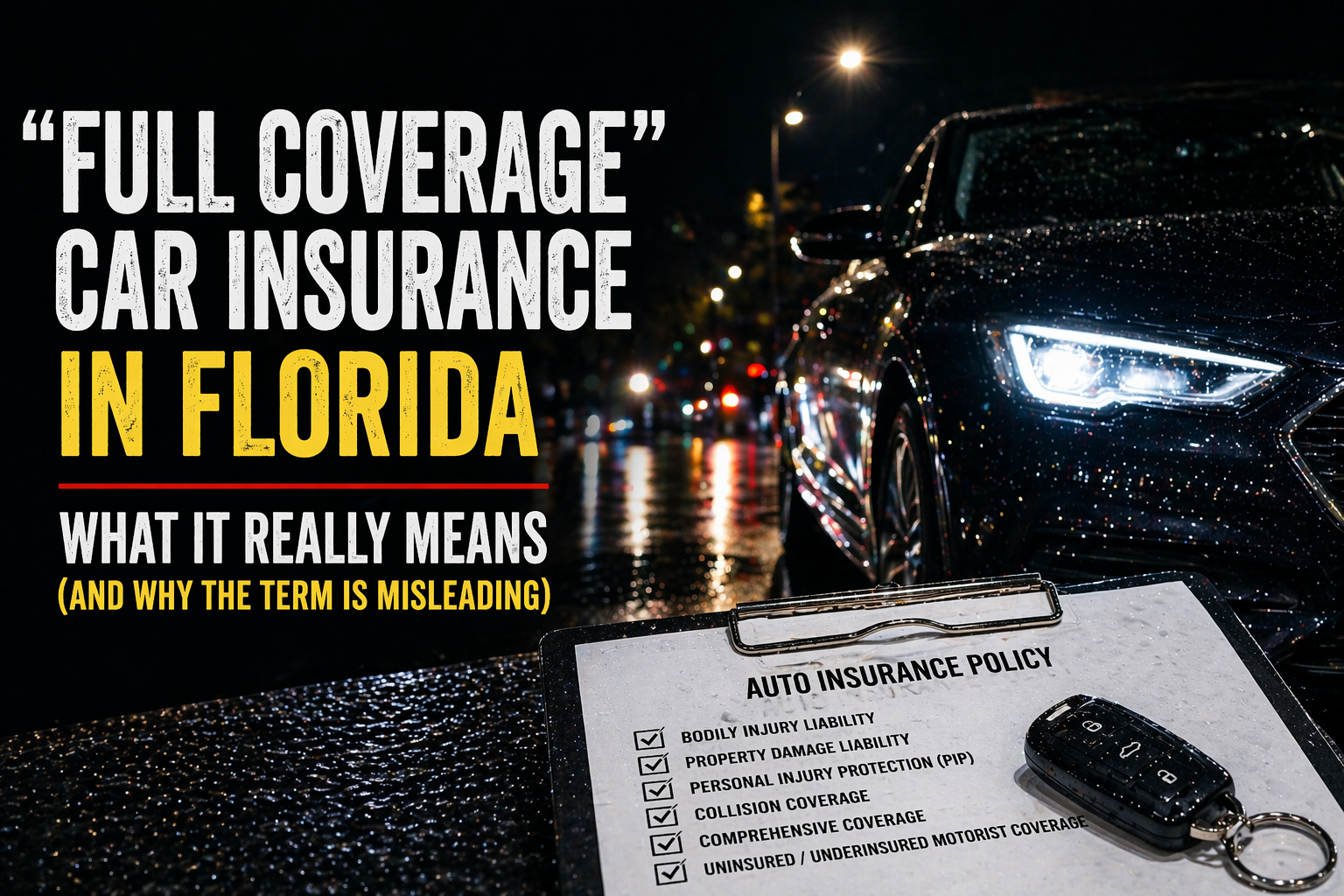
In real-world conversations, “full coverage” usually means you have liability coverage plus coverage for damage to your own car.
That typically includes bodily injury liability, property damage liability, personal injury protection, collision, and comprehensive.
That’s what most people think “full coverage” means.
The Problem: “Full Coverage” Doesn’t Mean You’re Fully Protected
Even if you have all of that, you still may not be properly protected.
Real protection comes down to your limits, your structure, and whether your coverage actually reflects your real-world risk.
For example:
You can have “full coverage” with 10/20 bodily injury limits and still be dangerously underinsured in a serious accident.
You can have “full coverage” but no uninsured motorist coverage — which means if someone hits you with no insurance, you’re left exposed. That’s not a small gap either. I broke that down in more detail in my article on how uninsured motorist coverage really works in Florida.
You can also have “full coverage” with a deductible that sounds fine on paper, but realistically wouldn’t be easy to pay if something actually happened.
So no — “full coverage” does not mean complete protection.
What’s Actually On Your Policy
Instead of focusing on the phrase, here’s what actually matters.
Liability coverage protects you if you cause an accident — this is the most important part of your policy.
Personal injury protection covers your own medical bills and lost wages and is required in Florida.
Collision and comprehensive cover your vehicle — this is what most people are referring to when they say “full coverage.”
A policy can include collision and comprehensive while still providing inadequate protection if the driver has not considered adequate liability limits.
And then there’s uninsured motorist coverage, which is one of the most important pieces of protection and one of the most commonly overlooked.
What I See Every Day
A client calls and says:
“I have full coverage — I’m good, right?”
We review the policy.
10/20 liability limits.
No uninsured motorist coverage.
$1,000 deductible.
Technically, yes — they had what most people call “full coverage.”
But in a serious accident, they’re exposed financially, under protected medically, and don’t realize it until it matters.
Why This Misunderstanding Costs People Money
This is where people get into trouble from both directions.
Some drivers overpay because they’re told they “need full coverage” without understanding what they’re actually buying.
Others underinsure themselves because they think they already have everything covered.
Focusing only on price makes this even worse. If you’re chasing the lowest number without understanding how it’s built, it’s very easy to end up with something that looks good on paper — but falls apart the moment you actually need it. I go deeper into that here: why the cheapest insurance isn’t always the smartest option.
The Better Question To Ask
Instead of asking, “Do I have full coverage?”
Ask:
What exactly does my policy cover — and what are my limits?
That’s where the real answers are.
My Approach
I don’t think in terms of “full coverage.” I think in terms of your liability exposure, your vehicle, your financial risk, and how all of it actually works together.
Because auto insurance isn’t about checking a box on a form. It’s about structuring the policy correctly the first time, so it actually holds up if you ever need it.
The Bottom Line
I’ve had this same conversation hundreds of times, and it almost always ends the same way — someone realizing they’d been thinking about their policy in the wrong terms the whole time. That’s not their fault. It’s just how the phrase got passed down over the years.
“Full coverage” is a phrase, not a policy. It doesn’t guarantee anything, and it definitely doesn’t promise complete protection.
Even when physical-damage coverage applies, the payment is generally based on actual cash value, so it helps to understand how total-loss settlements are calculated.
If you want to be properly protected, you need to understand what you actually have — and what you don’t. That’s a five-minute conversation, but it’s the conversation that matters.
Want Me To Take a Look at Your Policy?
If you’re not sure what your coverage really does — or whether it actually protects you — I’m happy to walk through it with you.
No pressure. Just a clear explanation.
Related Florida Auto Insurance Guides
Whether you’re buying a new policy, comparing quotes, understanding Florida insurance laws, or looking for ways to lower your premium, these in-depth guides will help you make more informed insurance decisions.
• Florida Auto Insurance – Start with our complete guide to buying, comparing, and understanding Florida auto insurance from the ground up.
• Florida Auto Insurance Coverage and Claims – Learn how liability, collision, comprehensive, uninsured motorist coverage, and the claims process work before you ever need them.
• Florida Auto Insurance Laws and Requirements – Understand Florida’s insurance laws, minimum coverage requirements, FR-44 and SR-22 filings, and the legal responsibilities every Florida driver should know.
• Safe Driving & Saving Money – Discover the many factors that influence your premium, practical ways to reduce your insurance costs, and how smart driving habits can help you save over time.
• Florida FR-44 Insurance – Everything Florida drivers need to know about FR-44 insurance after a DUI, including filing requirements, reinstatement, non-owner policies, and affordable coverage options.
Continue Reading About Florida Auto Insurance Coverage & Claims
If you found this guide helpful, these articles explore Florida auto insurance coverage, claims, and settlement issues in greater detail:
Florida Auto Insurance Coverage & Claims: What Your Policy Actually Does — And What Happens When You File a Claim (This article) – Start with our complete guide to understanding what your Florida auto insurance policy covers, how claims work, and how to make smarter coverage decisions.
How Much Liability Insurance Do I Really Need in Florida? – State minimum limits may satisfy Florida law, but they may not adequately protect your income, savings, or future. Learn how to choose liability limits that fit your personal financial situation.
What Is Full Coverage Car Insurance in Florida? (This article) – Many people ask for “full coverage,” but the term has no legal or insurance definition. Find out what it usually includes and how to decide whether it’s appropriate for your vehicle.
Uninsured Motorist Coverage in Florida – What happens if the driver who hits you has little or no insurance? Learn why uninsured motorist coverage is one of the most valuable protections many Florida drivers can buy.
Florida Minimum Car Insurance Isn’t Always the Bargain It Looks Like – Florida’s legal minimum looks cheap upfront, but can cost more later in pricing and real exposure.
Do You Really Have to Call Your Insurance Company After a Minor Accident? – Not every accident automatically requires an insurance claim. Learn when reporting an accident makes sense, what happens after you report it, and how your decision can affect future premiums.
That Total Loss Number Doesn’t Look Right – Receiving a total loss settlement can be frustrating if the value seems too low. Learn how insurance companies determine actual cash value and what you can do if you disagree with the offer.
C.L.U.E. Reports: The Hidden Claim Record – Most drivers never realize that claims can continue affecting their insurance long after an accident is over. Learn what a C.L.U.E. report is, what information it contains, and why reviewing it can help you avoid surprises.
About the Author
Written by Clifford Schimek — Florida Auto & FR-44 Insurance Expert
I help Florida drivers every day with auto insurance quotes and FR-44 filings. Terms like “full coverage” get thrown around a lot, but knowing what’s actually on your policy — not just the label — is what protects you when it matters. My goal is to make everything simpler and less stressful, no matter where you live in the state. If you ever need help or just want a straight answer, you can always call or text me directly.
Clifford Schimek — Florida Auto & FR-44 Insurance Expert
Call or text: 305-796-2968
Learn More About Cliff
Why Clifford Schimek? – The case for working with me
Florida Auto Plus Insurance – Agency website
Florida FR-44 Information and Guidance – For Florida drivers who need an FR-44 filing
View my Google Business Profile – Reviews and Business information